History
Founded by Bombay Education Society in memory of Archdeacon George Barnes, Barnes School & Junior College is one of India's largest co-educational day and boarding schools. It laid its foundation on 29th January, 1925. Initially, the school was established for Anglo-Indians; both boys and girls to give them good upbringing and sound education. Barnes School is twinned with Christ Church School in Mumbai, sharing a deep-rooted heritage and aim to academic excellence.
Both institutions follow the ICSE curriculum and use the same distinctive shield as their emblem - Barnes in blue and Christ Church in green. As a Church School, Barnes continues to uphold and impart Christian ideals, solidifying a nurturing environment grounded in faith, integrity, and service.
With a long-standing tradition of distinguished educational service, the school embraces the students of varied caste and creed. In the early 1900s, the Bombay Education Society (BES) joined hands with the Indo-British Institution, which had been started in 1837 by Rev. George Candy.
By that time, the Byculla area in Mumbai had become overpopulated and unhygienic. So, Sir Reginald Spence and Mr. Haig-Brown began planning to shift the boarding school to a better location.
They chose Deolali, a cooler and cleaner place, and bought over 250 acres of land there. On 17 November 1923, Sir George Lloyd laid the foundation stone for Evans Hall. Less than two years later, on 29 January 1925, the first group of boarding students arrived by train, and the new school at Deolali—called Barnes—was officially opened by Sir Leslie Wilson, the Governor of Bombay.
Many buildings at the school are named after important people who helped build and support it, like Barnes, Candy, Spence, Haig-Brown, and Lloyd. Greaves House is named after Sir John Greaves, a businessman who helped run the BES for many years.
Royal House honors Harry Royal, a former student who later worked with the Bombay Chamber of Commerce and helped the school financially. The most important figure was Rev. Thomas Evans, who led the school in Byculla from 1910 and became the first Headmaster of Barnes. His portrait still hangs in Evans Hall, which was named after him when he retired in 1934.
Venerable Archdeacon George Barnes
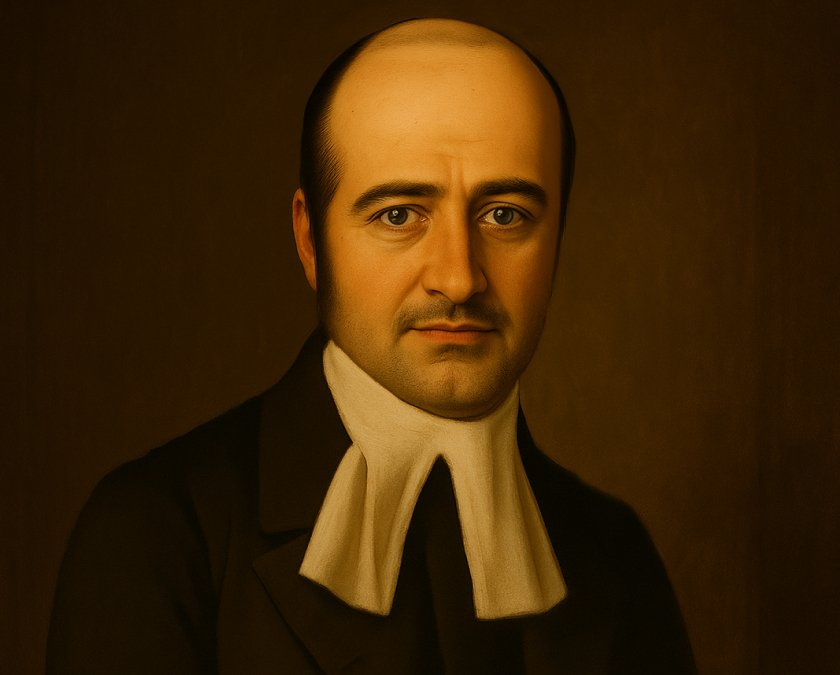
On January 27th 1815, the Venerable Archdeacon George Barnes, the Senior Anglican Priest in Western India, delivered a powerful sermon at St Thomas' Church, Bombay (now the Cathedral of St Thomas), asking support for the education of poor European and Anglo-Indian children. Inspired by his appeal, the BES was founded on that same day, with Sir Evan Nepean, then Governor of Bombay, as its first President.
Though Archdeacon George Barnes lived in India for twelve years (1814 to 1825), his impact was profound. Along with the establishment of BES, he also founded five churches across India - St James, Thana; Christ Church, Surat; St Paul's, Kaira ( in Gujarat); St James, Baroda and St Mary's, Poona.
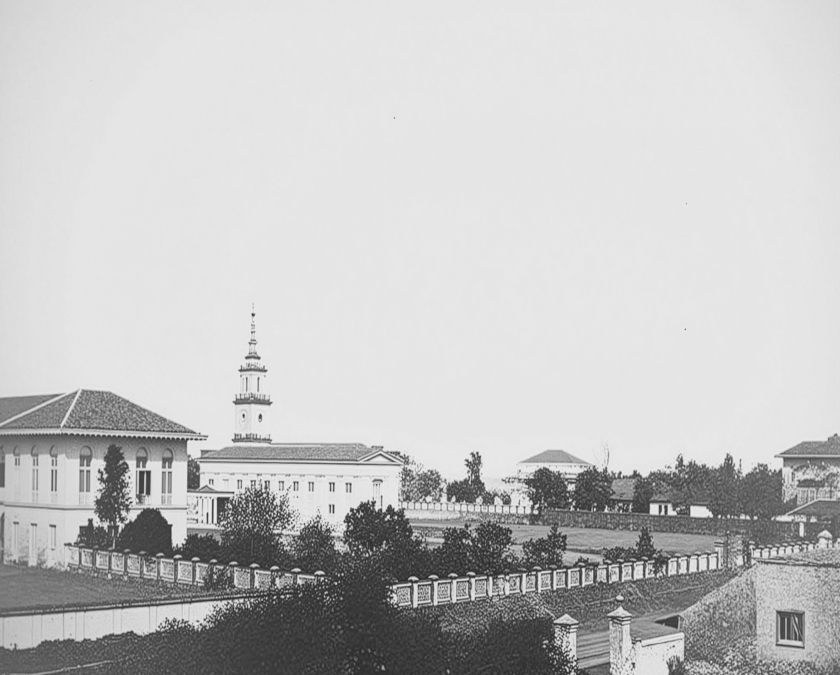
In the chancel of Exeter Cathedral in England, a commemorative tablet honors the memory of George Barnes D.D., the first Archdeacon of Bombay. The inscription placed by The Dean and other members of the Chapter pays tribute to his devoted service: after spending twelve wonderful years in India, he returned to his homeland and was appointed as Archdeacon of Barnes table and Rector of Sowton in the Diocese of Exeter. He won the affection of his friends and respect of all good men by his earnest, humble, and sincere behavior.
He passed away on 29th, June AD. 1847, leaving behind his legacy of faith and education.
The Crest
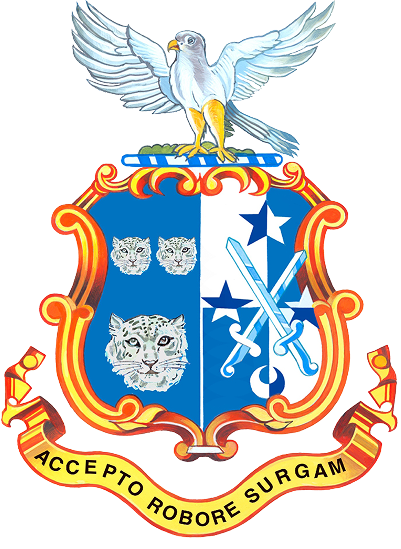
The crest of Barnes School & Junior College is the symbol of tradition and unity that combines the distinguished Coats of Arms of two noble families: the Barnes and the Carnac.
The left side of the shield, a blue shield adorned with three white leopard faces, represents the family of our founder, the Venerable Archdeacon George Barnes, the first Archdeacon of Bombay. The shield’s right half features four alternating blue and white quarters, representing the Carnac family—the lineage of George Barnes’ spouse.
Two steel-colored crossed swords, pointing upward, signify valor and readiness.
Three five-pointed stars and a white crescent alternate across the quarters, symbolizing aspiration, guidance, and renewal. A white falcon with a golden beak and legs, perched on a green mount, crowns the crest. It is encircled by six alternating twists of white and blue, representing unity and continuity.
The motto, ‘Accepto Robore Surgam’ in Latin, can be interpreted as, ‘I shall arise with the strength I have received’. (From the College of Arms, London)